Sunday, July 27, 2014

Orangeband Surgeonfish or unicornfish - Acanthurus olivaceus

It took me some time and effort with books and the internet to find a name for my most recent favorite snorkel buddy.
 
I'd followed a triggerfish several yards/meters off to the side from where I'd been snorkeling recently. There I saw a fish I hadn't seen before darting around on the sandy bottom and around the coral. I later learned that what I saw is its typical behavior which I've seen several times now.
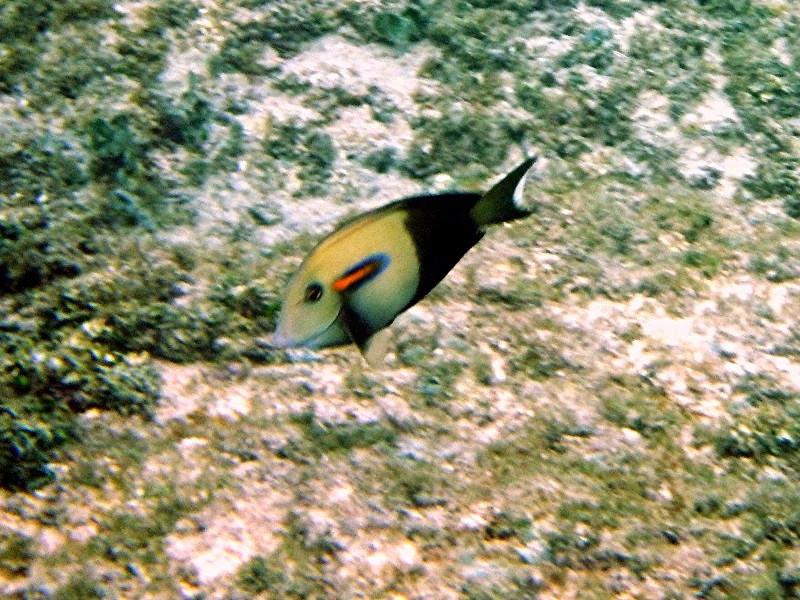
 
 
I loved its bright colors and seeming smiley face, a feature seen on several of the surgeonfishes.


Actually the descriptions I've seen say the Orangeband has a white front and the back goes gradually from gray at mid-body to a black tail. That is the description of the ones in Hawaii and obviously the local one is different. Its front is more of a tannish yellow and the back section goes from black to a gray tail. But in both cases they have the bright orange band in the front section for which they are named.

 
The Northern Mariana Islands are listed as one of its native habitats. It is seen alone, in pairs or in small groups feeding on the sandy bottom or coral which is where I’ve seen it here in shallow water at Kammer Beach.  It also may be seen near other fish.
 
 
From what I've read it seems juveniles are all yellow so I 'think' the following are juvenile Acanthurus olivaceus or Orangebands.

 
At any rate I always love seeing my smiley finned friend when I snorkel. Now that I know where it hangs out I expect to see Orangeband often.
 
BTW - the Surgeonfishes get their name from two sharp spines they have at the base of their tail. When feeling threatened it can pop them out to use. Those scalpel sharp weapons gives them their name. So I won't be attempting to pat my buddy or 'shake hands'! A smile will suffice. :>)


Birds and stuff


This morning the sky was gray, gray, gray but I ventured out anyway. Since yesterday the sea has been shouting. I tried to convince myself yesterday that I could hear it so much just because the wind had shifted. Well the wind did shift but the sea IS shouting too. That means too much turbulence for me to consider snorkeling. The normally very calm area at Kammer Beach where I snorkel most lately was more white than aqua today. I'd have been bobbing around like a cork in a bathtub with an energetic kid. But the moderate to strong breezes feel great and the rain is more off than on today. In fact the sun kept trying to push through.
 
 
Of course it can be worse when there is more 'serious' weather out to sea or nearby, as it was earlier this month when the same area looked more like this.

 
When the sea is rough it is fun to watch the waves break and spray at Taga Beach. 

 
But I'm usually bird watching in the morning anyway.
Today here was a Chunge’ (White tern) fledgling in the tree near the bandstand gripping on like it plans to never let go - with one then both parents supervising from anotherbranch – below and behind the little one.
 
 
Probably that’s the fledgling's landing perch from its first flight. These birds do not make nests and the young instinctively grasp onto a branch upon hatching and never let go until they fledge. How terrifying it must be to be goaded into letting go for the first time and launching oneself into open air. I imagine it is also instinctive to flap those wings and then a new perch must feel very reassuring.
An adult came squawking almost in my face – I guess it thought I was too close to its wee one.
 
The White-Throated Ground Doves (who are rarely seen on the ground) have a nest in another tree at the Fiesta Grounds. It has been tended by the Apaka(m) most of the time I've been there recently but today the Fachi(f) was there as well and it was being tended by both parents. And both were pretty busy, changing positions and poking down into the nest frequently. I suspect there is a hatchling or two there and they are getting restless. I’m just guessing but usually the sitting parent is almost like a statue.

 
One picture, though not clear enough to be sure, seems to show a tiny head in front of the Apaka's white chest. Of course it could just be one or a clump of those little ironwood 'pine' cones but it is more fun to think it 'might' be a hatchling.  


On the way back home, going along the beach I was surprised to see we might have a Kammer ‘Ness’ monster.
 
 
But on closer examination it seemed to be a much less exciting branch bobbing around in the water. Ah well, what’s an imagination for anyway!


Saturday, July 5, 2014

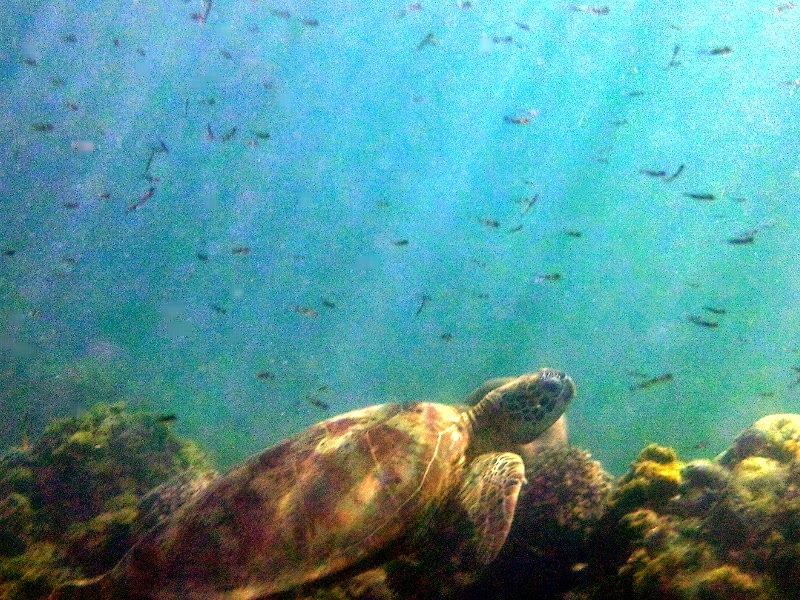
Snorkeling with Tinian turtles June 2014

My recent snorkeling adventures have included swimming with some turtles. Most just swim away and give few opportunities for photos. But one came toward me then circled around me seeming just as curious about me as I was of the turtle. Once right after that I saw two together but one swam off to the south too fast for me to snap any pictures the other took a leisurely northern route eyeing me enough that I think it may have been the same one as a couple of days before.


The day the turtle circled me I snapped a selfie to show what turtle was so interested in! Surely enough to bewilder any sea creature!
 
Before the recent snorkel sightings I'd only seen turtles from shore.

 
Frequently the pop their head up for air and back down usually too quickly to get a picture.
 
 
But sometimes they seem to be examining us and remain on the surface for several seconds in water shallow enough that we can even see some of the shell.

 
On occasion we even see more than one at a time.
 
BUT, in my opinion the most fun is swimming with them.
 
To my knowledge Tinian's Green Sea Turtles are benign and safe to swim with. I've never heard of a turtle attack or bite.


Wednesday, May 28, 2014

Underwater - butterfly fishes


Very recently I received a new underwater camera and am still fumbling around trying to learn its features and get some fish pictures.

Besides a heap of total duds I managed these mediocre ones on the first day.


I’m not very conversant on the fishes and they tend not to converse with me. So I turned to the internet where I discovered the Butterflyfish category that seems to cover today’s post. Wikipedia says:

“The butterflyfishes are a group of conspicuous tropical marine fish of the family Chaetodontidae; the bannerfishes and coralfishes are also included in this group. The approximately 120 species in 10 genera[1] are found mostly on the reefs of the Atlantic, Indian, and Pacific Oceans. A number of species pairs occur in the Indian and Pacific Oceans, members of the huge genus Chaetodon.

Butterflyfishes look like smaller versions of angelfish (Pomacanthidae), but unlike these, lack preopercle spines at the gill covers.”

That’s verging into more than I understand yet. I welcome any efforts in comments to expand my meager knowledge - ie: PLEASE, if you can, help me identify and learn about the fish I post. And if you are as ignorant about tropical fish as I am but like seeing the pics anyway – well we can struggle along together.

Oh, you can click on the pics to see a larger version.

Tuesday, May 27, 2014

Pacific Reef Heron

Today the Pacific Reef Heron came to visit.
It likes the seawall and the area behind it!


Whether the same bird or not,
I don't know, 
but this species has come to visit
the sea wall area in the past too.


With its incredibly long and flexible neck,
it has proven itself to be
a rather acrobatic contortionist at times.


Thursday, February 21, 2013

A Nesting Bird Bonanza!

The doves were really out to please at the Fiesta grounds today. Yesterday I saw a pair of Mariana Fruit Doves and thought they might have or be creating a 'nest'. - Today I just looked upward to search out the Fruit dove I saw yesterday when the male flew right over to her – if I’m right about who is which (the coloring of males and females is either the same or too similar for me to tell). That saved me from having to search to spot her. He didn’t stay long but as far as I was concerned he’d done me a nice favor. A couple of days ago I spotted a male White-throated Ground Dove. Watching it I soon decided it was in attendance of a female on a nest. The nest is just was very loosely knit assemblage of long ironwood needles. But yesterday I could not find that nest anywhere. I figured they had just been ‘house hunting’ and opted for a different neighborhood. While watching the Mariana Fruit Dove I hadn’t much hope of sighting the White-throated Ground Dove but “Lo and Behold!” A male flew over and perched close enough to the Fruit dove that I got off a shot including them both. He then began flying back and forth between two other trees and that me helped locate their nest. It is a tree away from where I thought I saw it the other day. So either I was looking in the wrong tree yesterday or what I really think is they chose a different spot. Unlike the Fruit dove male this one makes many quick trips to the nest and away. And in each tree he’d walk, hop or flutter from branch to branch. - Gradually he would approach the nest and briefly join her there. While the White-throated nest is merely a large mass of loosely assembled needles it does keep them much better hidden from the ground – thus from the camera. I could detect her head or tail at times. And when he’d join her, I could get an occasional shot of him at the nest. He just never hangs around for long though. - The ‘nest’ for the Fruit dove if it can be called that is only a small collection of ironwood needles. She stayed close to the 'nest' today but did do some moving around. - - Now the really great news is that I can watch both nests from each of a couple of different spots. So I don’t always have to fear missing a visit at one when watching the other. Some of the best shots are from other spots but when nothing is happening I can position myself at the ready for either nest. This is an an exciting opportunity as being shy this is about the only time one can observe then. Both birds are striking with the Fruit dove being out most colorful bird. - This truly was a Bonanza Nesting Bird Day. Two rather shy species to watch at once!